

Most food and beverage manufacturers know traceability is non-negotiable. What trips people up is something more specific: traceability has to work in two directions, and most operations have only fully solved one of them.
Forward and backward traceability are not two names for the same thing. They answer different questions, serve different operational purposes, and in a real recall or audit you need both running simultaneously. One without the other is not a traceability program. It is a gap with documentation around it.
Here is what each direction actually means, where operations routinely break down, and what it looks like inside a facility that has genuinely solved both.
The clearest way to understand the difference
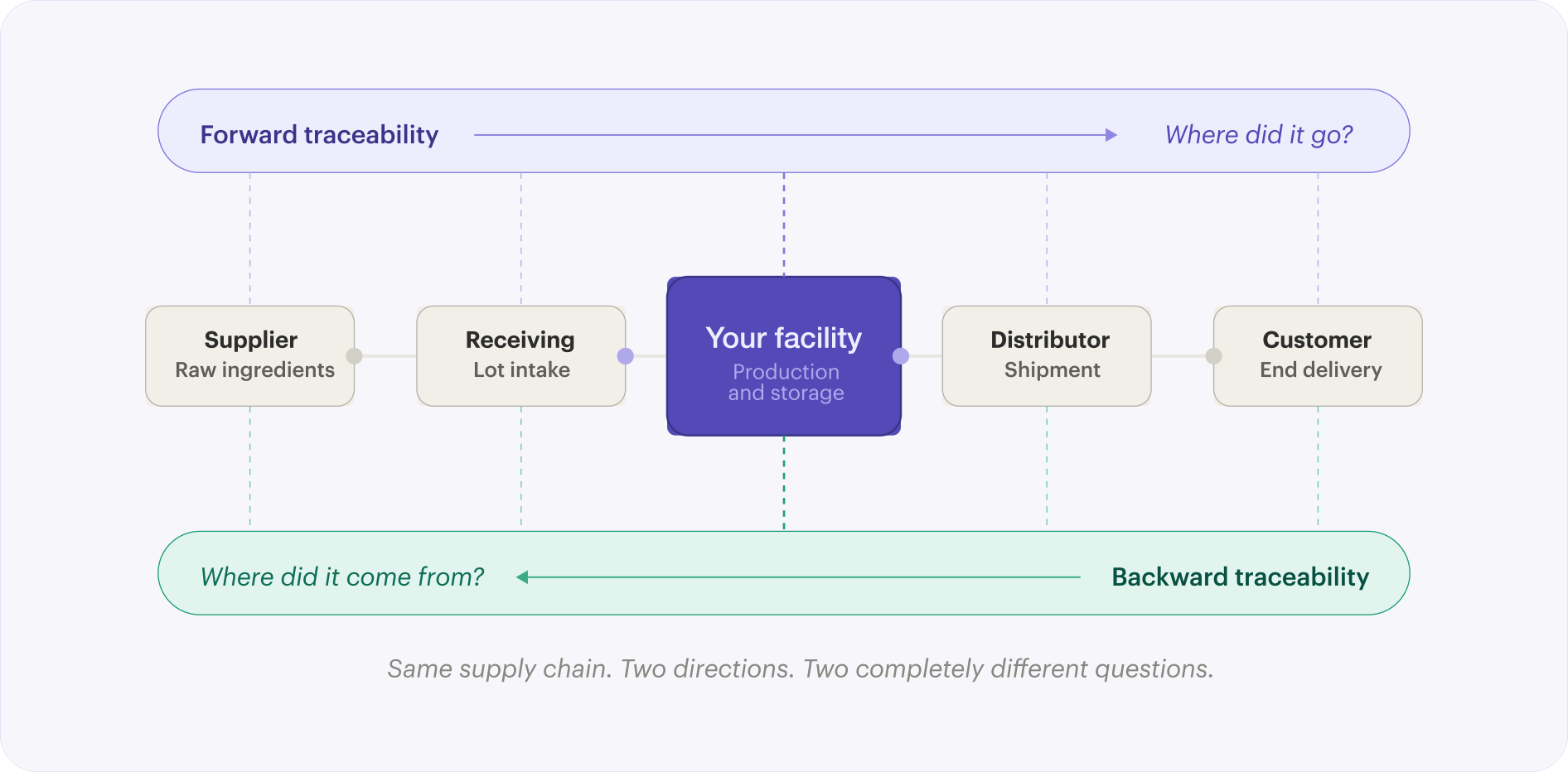
Backward traceability answers: "Where did this come from?"
Forward traceability answers: "Where did this go?"
Both move through your supply chain. They just run in opposite directions. And the one you reach for first depends entirely on where the problem originates. A contaminated ingredient calls for backward traceability. A recall notice about a finished product calls for forward. Most crises end up requiring both within the same hour.
Why backward traceability on its own is not enough
Imagine your supplier calls on a Wednesday morning to let you know a batch of oat flour is under investigation for possible Salmonella contamination. Backward traceability tells you which of your production runs received that flour and which finished product lots were built from it. That is genuinely useful. But it is not the hard part.
The hard part is what comes next: which of those lots already shipped, to whom, and where are they sitting right now? If that answer requires your operations manager to open three spreadsheets, call the warehouse, and then phone your co-packer to check their records, you do not have a traceability program. You have a scavenger hunt.
Backward traceability finds the root. Forward traceability maps the exposure. You need both to understand what you are actually dealing with.
Knowing where an ingredient came from is only half the answer. The question that keeps food safety directors up at night is where that ingredient ended up after it left your dock.
Why forward traceability on its own falls short too
Forward traceability tells you every place a finished product lot went. It is indispensable for conducting a recall efficiently. But without backward traceability, you are answering the wrong question first.
Say a customer flags a quality issue with your sriracha honey glaze. Forward traceability shows you every distributor and retail account that received product from that production run. But it cannot tell you whether the problem traces to a specific batch of chili mash, a shared mixer that also touched two other SKUs, or a pepper supplier whose lot you received three weeks earlier and used across eight separate production runs.
Scope and root cause are separate problems. One asks how far it went. The other asks why it happened. Answering only one of them while a recall is in motion is how small problems become large ones.
What this looks like in an actual facility
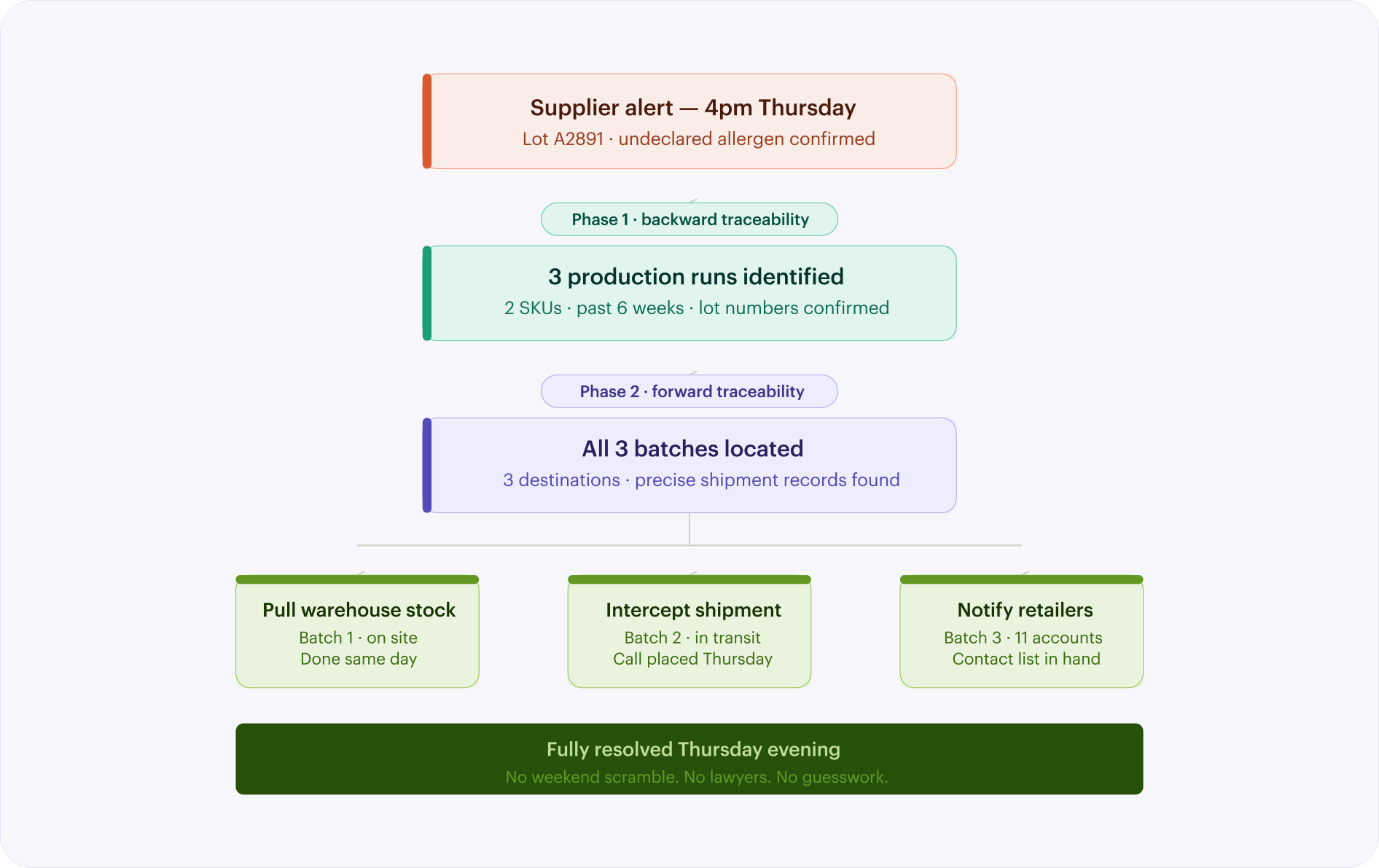
Your supplier calls at 4pm on a Thursday. Lot A2891 of a seasoning blend you have been running through your line is being recalled due to an undeclared tree nut allergen. They confirm the lot shipped to you six weeks ago.
Backward traceability gives you the answer to the first question in minutes: that lot touched three separate production runs across two SKUs. You have the batch records, the work orders, and the finished lot numbers before 4:30pm.
Forward traceability answers the second question just as fast: one of those finished lots is still in your warehouse, one left on a pallet to a regional distributor last Tuesday, and the third was broken into individual cases going to eleven retail accounts across four states.
By 5pm you have pulled the warehouse stock, called the distributor, and sent notification to all eleven retailers. You go home Thursday evening. The alternative, without both directions working, is spending Friday on the phone trying to reconstruct shipment records that should have been one query.
What FSMA 204 actually requires
FDA's Food Safety Modernization Act Rule 204 mandates traceability records covering foods on the Food Traceability List, which includes most produce, shell eggs, nut butters, and an expanding range of ready-to-eat products. If your products fall under this rule, you are required to maintain records going in both directions: from the source of your ingredients to the finished product you produced, and from that finished product through to its first point of sale or distribution.
You must also be able to produce a complete traceability report within 24 hours of an FDA request. That report needs to document Critical Tracking Events at every stage of the chain, each tied to Key Data Elements including lot codes, quantities, locations, and dates.
The regulation does not use the words "forward" and "backward" but the recordkeeping requirements are built around both directions. You need documentation showing where your ingredients came from and documentation showing where your finished product went. Gaps in either direction are gaps in compliance.
If you are unsure whether your product line falls under the enhanced traceability requirements, the FDA's Food Traceability List is the starting point. It is updated periodically and the scope has been expanding.
Where most operations actually break down
The failure mode almost never looks like "we have no traceability." It looks like partial traceability dressed up to look complete. Here is what that actually means on the floor.
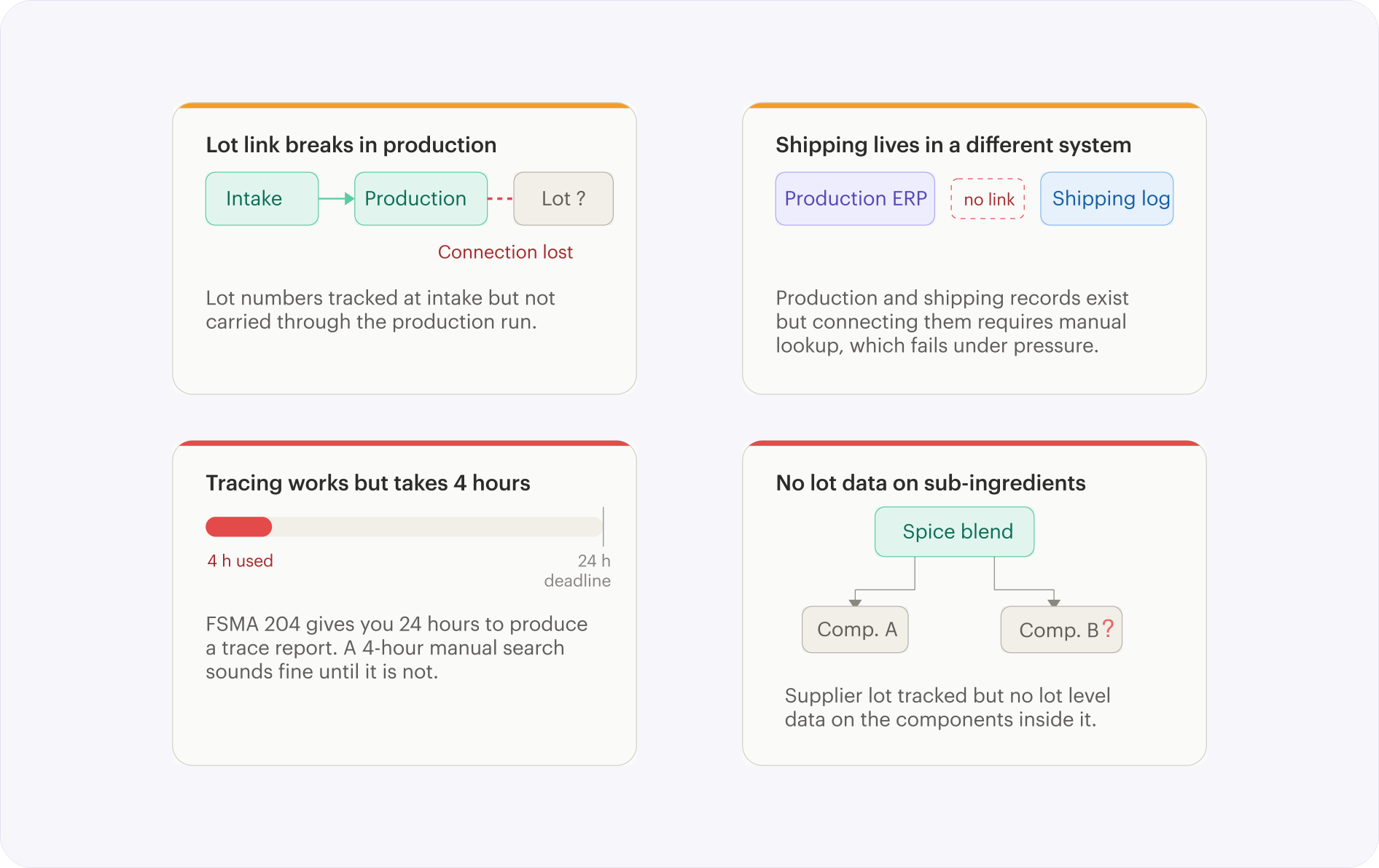
Lot numbers tracked at receiving but not through production
Your receiving team logs every supplier lot number. But when that ingredient goes into a batch, the connection breaks. The finished product lot number exists in isolation. You can prove what you received but you cannot prove what you made from it or which production runs are at risk if a supplier lot is flagged later.
Shipping records living in a separate system from production records
Your production system knows what was made and when. Your shipping system or 3PL knows what left and where it went. But they do not talk to each other. Connecting a finished lot to a specific outbound shipment means someone manually cross-referencing two systems under pressure, which is exactly when manual processes fail.
Bidirectional traceability that technically works but takes hours
FSMA 204 gives you 24 hours to produce a complete traceability report when the FDA requests one. That sounds like plenty of time until you realize your team needs four of those hours just to pull the records, another two to verify them, and an hour to format the response. Twenty-four hours goes fast when a recall is also in motion and your phone is ringing.
Compound ingredients with no component lot visibility
Your supplier provides lot numbers for bulk ingredients. That part works. But your spice blend, your premix, your flavoring system each contain multiple components, and you have no lot visibility into those individual inputs. When one of those components is flagged, you cannot determine whether your specific lot is affected without calling the supplier and waiting. That waiting has a cost during an active recall.
What a complete traceability system actually looks like
The benchmark is not whether you technically have traceability records. It is whether any person on your operations team can answer either question, in either direction, in under five minutes, without calling anyone or opening a spreadsheet.
In a facility where this is genuinely solved, the data chain looks like this:
- • Every raw material lot is tied to every production run that consumed it
- • Every production run is tied to every finished product lot it generated
- • Every finished product lot is tied to every outbound shipment it left in
- • Every shipment is tied to the specific customer or distributor that received it
- • All of this is queryable in one place, in real time, without any manual assembly
When that chain is intact, a full trace in either direction takes minutes. When it is not, that gap costs you time on every audit, every customer dispute, and every recall. It is not just a compliance risk sitting dormant. It is an operational tax you pay continuously.
The case for traceability beyond the regulation
Regulatory compliance is the floor. The ceiling is using traceability data to operate better every day, not just during a crisis.
When you have bidirectional lot visibility across your full supply chain, you can see things that were invisible before. A finished product yield drop that correlates with a specific pepper supplier's harvest. A pattern of quality complaints that clusters around one distributor's storage conditions rather than your production process. A raw material lot you can clear from suspicion in a recall because your records prove it was received after the contamination window closed.
That kind of operational intelligence does not come from having records. It comes from having records that connect. Backward traceability and forward traceability are each half of that connection. Together they close the loop.
The bottom line
Traceability is not a single capability. It is two distinct ones that have to work simultaneously. Forward and backward. Origin and destination. Why it happened and how far it spread.
Every food and beverage manufacturer needs both. Not because the FDA requires it, though it does. Because the alternative is getting a supplier call on a Thursday afternoon and spending the next three days finding out you only had half the answer.
See Wherefour's traceability in action
Forward and backward traceability, lot tracking, and full recall reports in one place. See how it works for manufacturers like yours.
Get a Demo