Inventory · Compliance · Traceability · All in One Place
Wherefour is purpose-built for food and beverage producers, so lot tracking, FSMA compliance, and real-time inventory aren't add-ons. They're how the system works from day one.
Get a Demo See our Food & Beverage ERP →
Food Manufacturing ERP Software Trusted by Leading Food Brands
ERP stands for Enterprise Resource Planning, which is a way of saying it's the system that ties your whole operation together. For food manufacturers, that means inventory, production, purchasing, compliance, traceability, and financials all living in one place instead of scattered across a spreadsheet here, a separate inventory app there, and a QuickBooks file your accountant can only access on Tuesdays.
A general ERP is built for manufacturing broadly. A food manufacturing ERP is built for the specific realities of producing food, things like:
Those aren't features you can bolt onto a general platform. They're table stakes for food manufacturing, which is why purpose-built software almost always outperforms generic ERP for producers in this space.
One system for inventory, production, compliance, purchasing, and financials, not four tools duct-taped together.
Lot tracking, allergen management, and FSMA compliance are native features, not expensive add-ons you configure yourself.
Every transaction is logged automatically. When an inspector shows up, you're ready in seconds, not scrambling through spreadsheets.
"Wherefour is truly built out for traceability and it does not fail!"
— Kaylee, Production and Fulfillment
Inventory management in food manufacturing isn't the same as inventory management in electronics or apparel. Your inventory expires. It has allergen implications. It transforms raw ingredients become batches, batches become finished goods, finished goods get split into different SKUs for different customers and every step of that transformation needs to be tracked.
A general inventory system tracks what's on the shelf. A food manufacturing ERP tracks the full story of every item, where it came from, what it was used in, where it went, and when it needs to be acted on before it becomes a problem.
Custom and automatic lot code, barcode or serial number sequences that incorporate batch date, expiration date, julian date, facility, location, and more.
Automatically pull ingredients and supplies via FIFO, FEFO, LIFO or on a per-batch need.
Print GS1, Code 128 or Code 93 barcodes for product, inventory, package or pallet labels.
Receive automatic alerts for expiring products or low stock levels before they become a problem.
Not all ERP systems are built the same, and in food manufacturing, the wrong choice costs you more than money, it costs you time, compliance standing, and the ability to scale without chaos. Most generic ERP platforms were built for general manufacturing and retrofitted for food.
Here's what actually matters when you're evaluating options.
Not as a module. Not as an add-on. Every ingredient, batch, and shipment should be traceable from a single record because when a recall happens or an auditor shows up unannounced, you don't have time to dig through multiple systems.
FSMA 204, SQF, HACCP — your ERP should handle audit-readiness automatically. Attach COAs to raw materials, log every transaction, generate recall reports in seconds. The system should do the work, not your team.
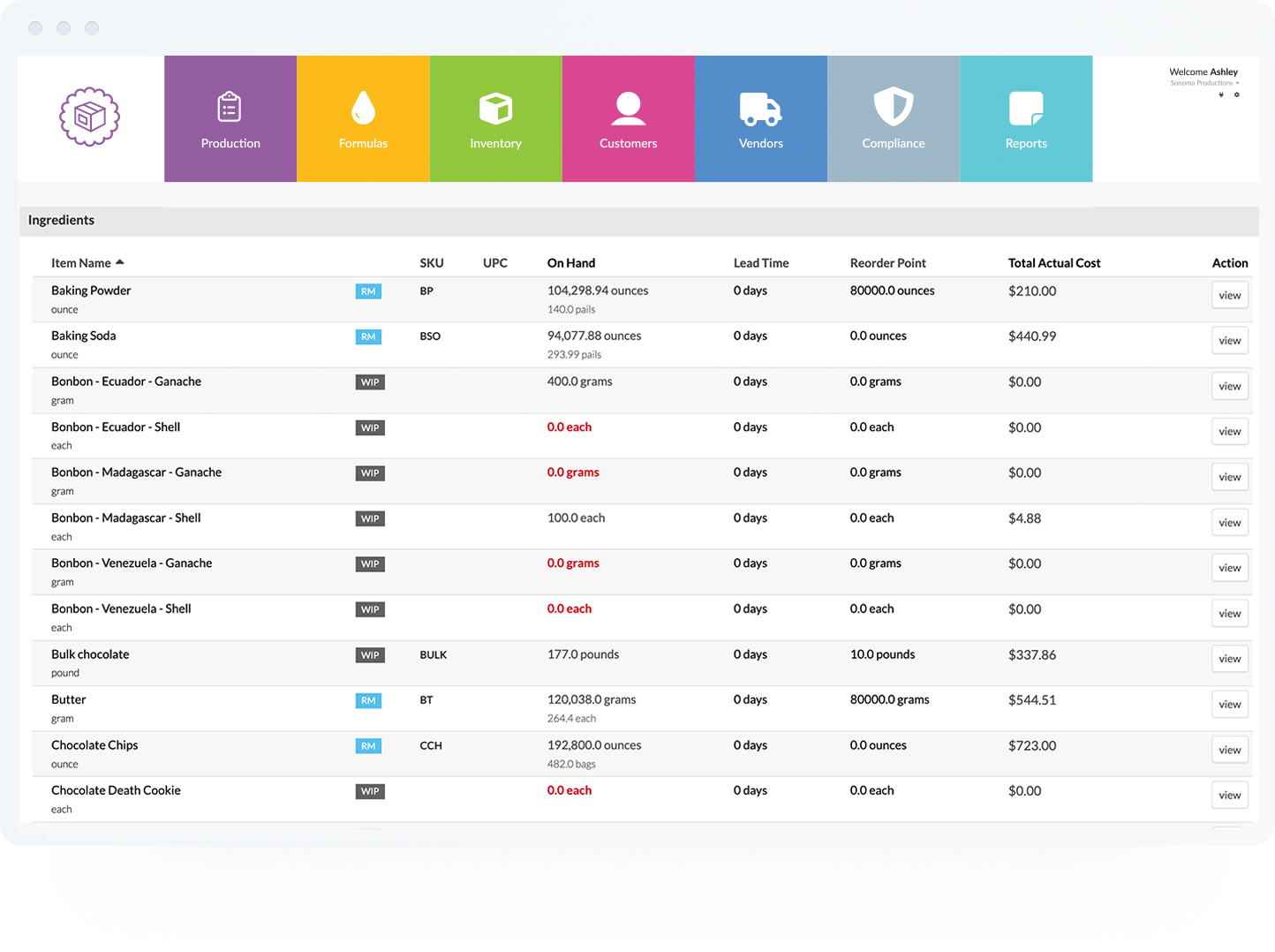
Across every location. If you're guessing what's in your warehouse, that's the system failing you. You should be able to drill into any item and see exactly what's on hand, where it is, what it cost, and where it came from.
QuickBooks, Xero, Sage, and Microsoft Dynamics should talk to your ERP, not exist in a separate universe. Journal entries, COGS, and invoices should flow automatically without your team touching them twice.
Onboarding a new ERP is a real undertaking. You shouldn't be doing it alone. Look for a team that stays with you through go-live and beyond, not one that hands you a manual and disappears. Wherefour was built specifically for food and beverage manufacturers, and our implementation team has years of manufacturing experience.
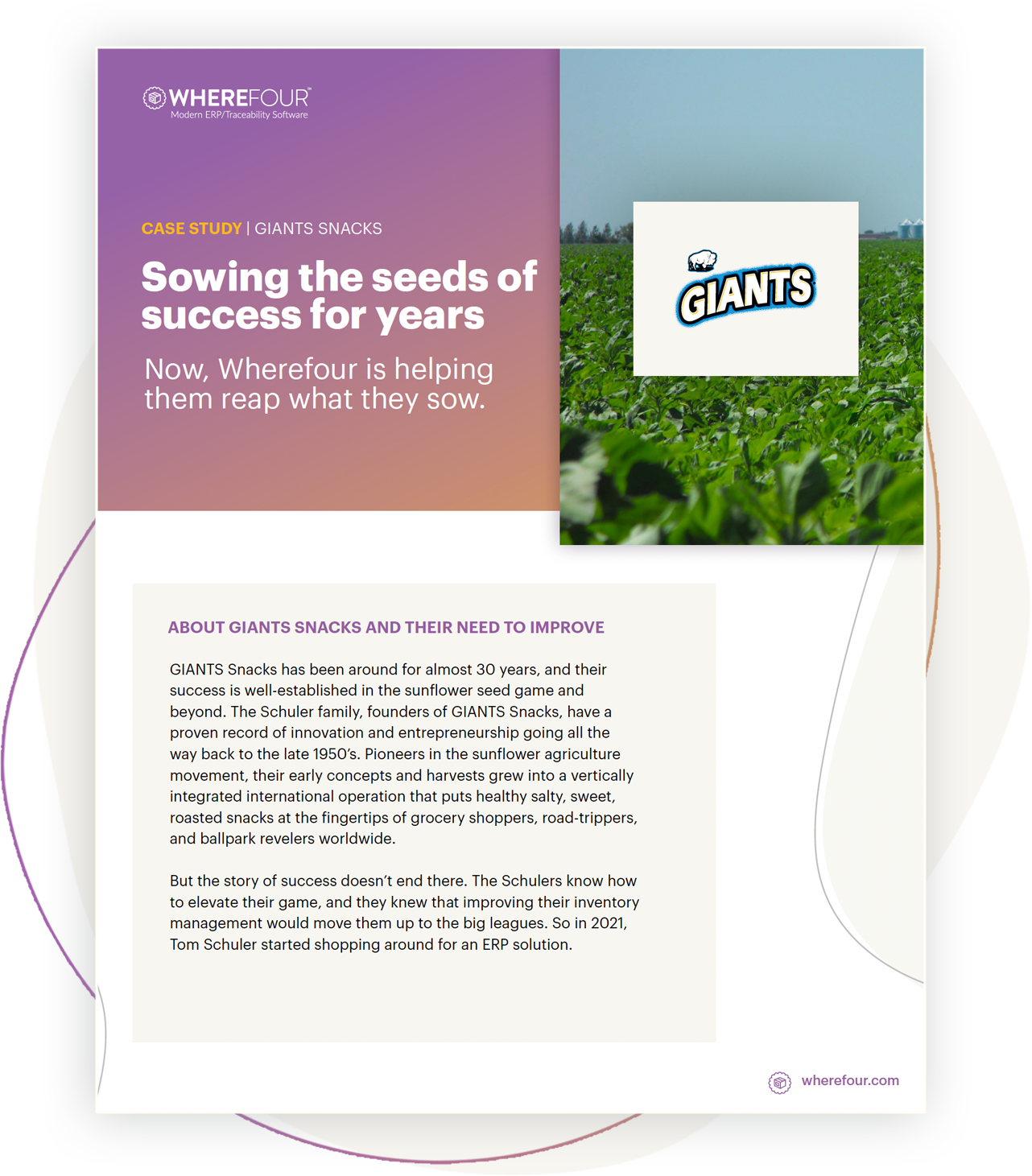
GIANTS has been experiencing continual growth since its beginning, and using Wherefour's food manufacturing ERP software coincided with a huge growth spurt. Recently, GIANTS embarked on a major building expansion, more than doubling its footprint. Kristen Mumm, the production manager at GIANTS Snacks, says Wherefour gave the company the confidence to process and track all orders and achieve a bigger facility.
Read their storyOne of the biggest reasons food manufacturers put off switching to an ERP is fear of the rollout. Stories of months-long implementations, expensive consultants, and teams that never fully adopt the system are common enough to be a real deterrent.
The honest answer is: it depends on who you work with.
Wherefour's implementation is structured differently from enterprise ERP deployments. There's no army of consultants, no 12-month timeline, and no situation where you're handed off to a support team who wasn't part of your onboarding. Your dedicated team works with you directly to get your data migrated, your team trained, and your workflows configured in weeks, not quarters.
"Wherefour is very user friendly, and well suited to our food manufacturing business. The customer support is second-to-none, and from implementation to process integration to product launch we were well taken care of at every step."
— Joshua, Director of OperationsWhat that looks like in practice:
Kickoff call
Map your specific workflows, compliance requirements, and integrations before a single thing is configured.
Data migration
Move your existing inventory, recipes, and supplier records into Wherefour cleanly with support every step of the way.
Hands-on training
With your team on the floor, not just in documentation. Real workflows, real scenarios, real confidence.
Go-live with real support
A real human available to answer questions on launch day, not a help center article and a ticket queue.
Ongoing support
You'll work with people who actually understand what a lot code is. Same team, start to finish.
A common question from producers evaluating their options: "We're growing — but are we big enough for an ERP?"
The honest answer: if you're managing more than a handful of SKUs, working with multiple suppliers, shipping to wholesale accounts, or subject to any food safety regulation — you're already big enough. The question isn't whether you need a system. It's whether the one you have now is costing you more than it saves.
You're tracking inventory in spreadsheets and reconciling manually at the end of every week
A recall or audit would take days to pull records for, not minutes
Your production team and purchasing team are working from different versions of the same information
You've had to turn down new business because you couldn't forecast capacity or material availability with confidence
You're spending more time managing your tools than running your business
An ERP isn't an inventory tool or a production scheduler, it's the system of record for your entire operation. Here's how it connects the dots.
Set reorder points, receive automatic alerts, and generate purchase orders directly from your inventory data. When a supplier lead time changes or a raw material runs low, you know before it's a problem, not after a production run gets delayed.
Scale recipes, schedule batches, track yields, and monitor production runs in real time. Your team gets clear work orders on any device. You get visibility into what's happening on the floor without having to physically be there.
Real-time stock levels across every location, with full lot tracking and cost visibility. Expiration alerts, barcode scanning, and FIFO/FEFO logic keep your inventory accurate and your waste down. Every movement is logged with a complete audit trail.
Mock recalls take minutes. FSMA 204 reporting is built in. Attach COAs to raw materials, track allergens automatically, and generate audit-ready reports on demand. When an inspector shows up, expected or not, you're ready.
Manage wholesale accounts and your B2B customer portal from the same platform. Connect to Shopify, Amazon, and ShipStation so ecommerce orders flow directly into fulfillment without manual entry.
Sync automatically with QuickBooks, Xero, Sage, or Microsoft Dynamics. Journal entries, invoices, and COGS data flow between systems without your team touching them twice. True unit-level costing means you always know your real margins.
No pressure, just answers to help guide your next step.