

Manufacturers are under pressure to move faster, control costs, and keep production on track. Many legacy enterprise resource planning (ERP) systems struggle to keep up, because they rely on static data, manual inputs, and rigid workflows that slow decision-making.
AI is changing how ERP systems support manufacturers, especially when it comes to compliance, documentation, and audit readiness. Instead of relying on manual processes and disconnected records, teams can automate quality workflows, standardize documentation, and maintain real-time visibility into regulated processes.
This shift is accelerating by 2027, 62% of cloud ERP spending will go toward AI-enabled solutions. For manufacturers in regulated industries, AI is becoming less about prediction and more about staying compliant at scale.
In this guide to the best AI ERP software, you'll find the top platforms for manufacturers. We break down features, pros and cons, and pricing so you can choose the right system for your business.
What is AI ERP Software?
AI ERP software combines traditional ERP systems with artificial intelligence to automate workflows, analyze data, and support faster decision-making across operations. It uses automation and intelligent workflows to standardize processes, improve data accuracy, and support faster decision-making across operations. In regulated industries, AI is often applied to compliance workflows like QA processes, documentation management, and audit readiness.
Adoption continues to grow as AI becomes part of everyday business operations. McKinsey reports that 65% of organizations now use generative AI in at least one business function, pushing ERP systems to evolve beyond static reporting and manual processes.
Best AI ERP Software
We evaluated AI ERP software based on its ability to support real manufacturing operations. We looked at:
- AI capabilities: Workflow automation, compliance support, and documentation standardization
- Manufacturing functionality: Support for production, inventory, MRP, and traceability
- Ease of use and flexibility: Interface design, customization options, and implementation complexity
- Integrations: Ability to connect with accounting, MES, ecommerce, and other systems
- Scalability: Support for growing operations, multi-site production, and increasing data volume
- Customer feedback: Reported strengths and limitations from real users
| Software | Best For | Pros | Cons | Pricing |
|---|---|---|---|---|
| Wherefour | End-to-end manufacturing visibility and compliance | Strong traceability and recall readiness; inventory and production workflow connections; AI-assisted compliance tools | PDF template editor has a learning curve | Custom pricing |
| Acumatica | Flexible cloud ERP for SMBs | Customizable workflows; strong usability; connected financials and operations | Complex setup; longer implementation timelines | Not listed |
| Epicor | Manufacturing and supply chain operations | Deep industry functionality; strong forecasting and planning tools; flexible configuration | Inconsistent support; requires customization to optimize workflows | Not listed |
| Infor CloudSuite Industrial | Complex, industry-specific manufacturing environments | Built-in manufacturing tools; strong quality and traceability features; scalable infrastructure | Steep learning curve; documentation gaps for advanced use cases | Not listed |
| Microsoft Dynamics 365 | Integrated ERP and CRM environments | Strong Microsoft ecosystem integration; modular deployment; AI-powered Copilot tools | Complex implementation; advanced setup requires technical expertise | Varies by application and licensing |
| Oracle NetSuite | Unified ERP for global operations | Centralized data across business functions; scalable across entities and regions; strong reporting tools | Additional modules increase cost; complex interface for new users | Not listed |
| SAP S/4HANA | Large enterprises with global operations | Standardized processes; real-time analytics; strong enterprise integration | High cost; complex implementation and resource requirements | Not listed |
1. Wherefour


Wherefour is a cloud-based ERP system built for manufacturers that need real-time control over production and compliance. It connects MRP, traceability, and production workflows into a single platform, so teams don't have to rely on disconnected tools.
The system provides real-time visibility into ingredients, batches, finished goods, costs, expiration dates, and reorder points. Teams can manage production workflows, maintain accurate inventory levels, reduce manual tracking errors, and respond quickly to changes across operations. Built-in traceability supports forward and backward tracking, and the system generates recall reports in under two minutes using complete lot and customer data.
Wherefour's AI capabilities are focused on compliance and quality workflows. The platform includes AI-assisted tools that help teams create QA tests, standardize documentation, and maintain audit-ready records. This reduces manual work while helping businesses stay aligned with regulatory requirements.
Best for: Manufacturers in regulated industries that need strong traceability and AI-assisted compliance workflows
Features:
- Real-time inventory and lot tracking: Tracks stock levels, costs, and traceability data with support for FIFO, FEFO, LIFO, and custom lot selection
- MRP and production planning workflows: Plans production and purchasing based on current orders, available materials, and production requirements
- Full traceability and recall readiness: Tracks ingredients and batches across production with instant forward and backward traceability reporting
- AI-assisted compliance and QA workflows: Helps create test definitions, manage approvals, and maintain audit-ready documentation
- Connected production and inventory workflows: Keeps data aligned across production, inventory, and quality processes in one system
- Integrations with accounting and business tools: Syncs with platforms like QuickBooks and Xero to keep financial and operational data connected
Pros:
- Responsive customer support that guides implementation, integration, and product launch
- Robust software that handles complex scenarios without adding operational burden
- Easy implementation that requires minimal setup
Cons:
- The PDF template editor can take some time to master, but customer support helps shorten the learning curve.
Pricing: Wherefour provides custom price quotes depending on your company's specific needs.
Schedule a free demo with Wherefour today.
2. Acumatica

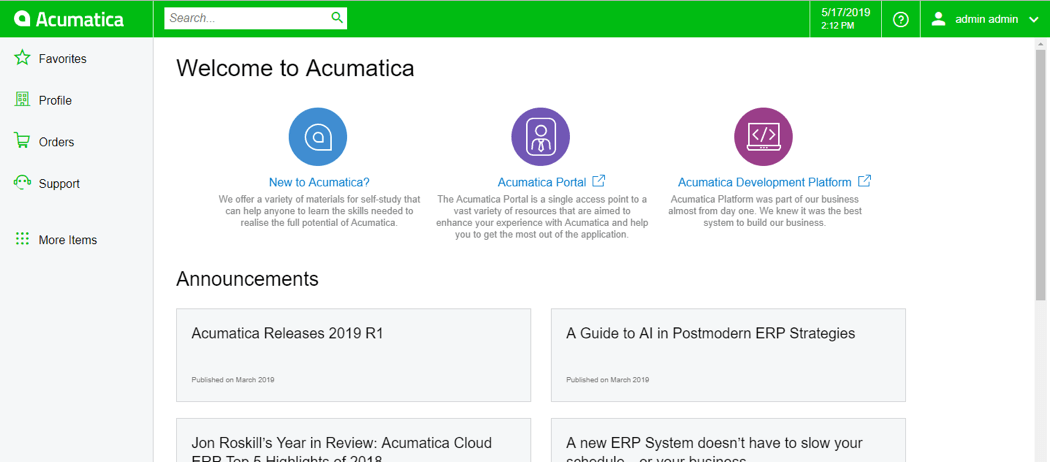
Acumatica is a cloud-based ERP platform that combines financials, inventory, manufacturing, and customer management into a single system. It uses AI-powered automation to handle workflows, detect anomalies, and generate insights from operational data. The platform includes configurable dashboards, role-based access controls, and a cloud-native architecture that supports integrations and ongoing updates. It also provides low-code and no-code tools for modifying workflows and supports cross-device access.
Best for: Small to mid-sized businesses needing flexible cloud ERP
Features:
- AI-powered automation and anomaly detection: Automates workflows, identifies exceptions, and generates operational insights
- Real-time data visibility and reporting: Provides live dashboards and analytics across business functions
- Cloud-native platform with flexible access: Supports secure access across devices with scalable infrastructure
- Low-code and no-code customization: Enables workflow and application changes without extensive development
Pros:
- Ease of use with user-friendly screens and seamless setup
- Customizable workflows that adapt to specific business processes without extensive development
- Cross-module connectivity linking financials, inventory, and operations in one system
Cons:
- The learning curve is steep, particularly for teams new to ERP-style interfaces
- The initial setup process can be complex and time-consuming, with some implementations taking over two years to complete
Pricing: Pricing not listed on website
3. Epicor

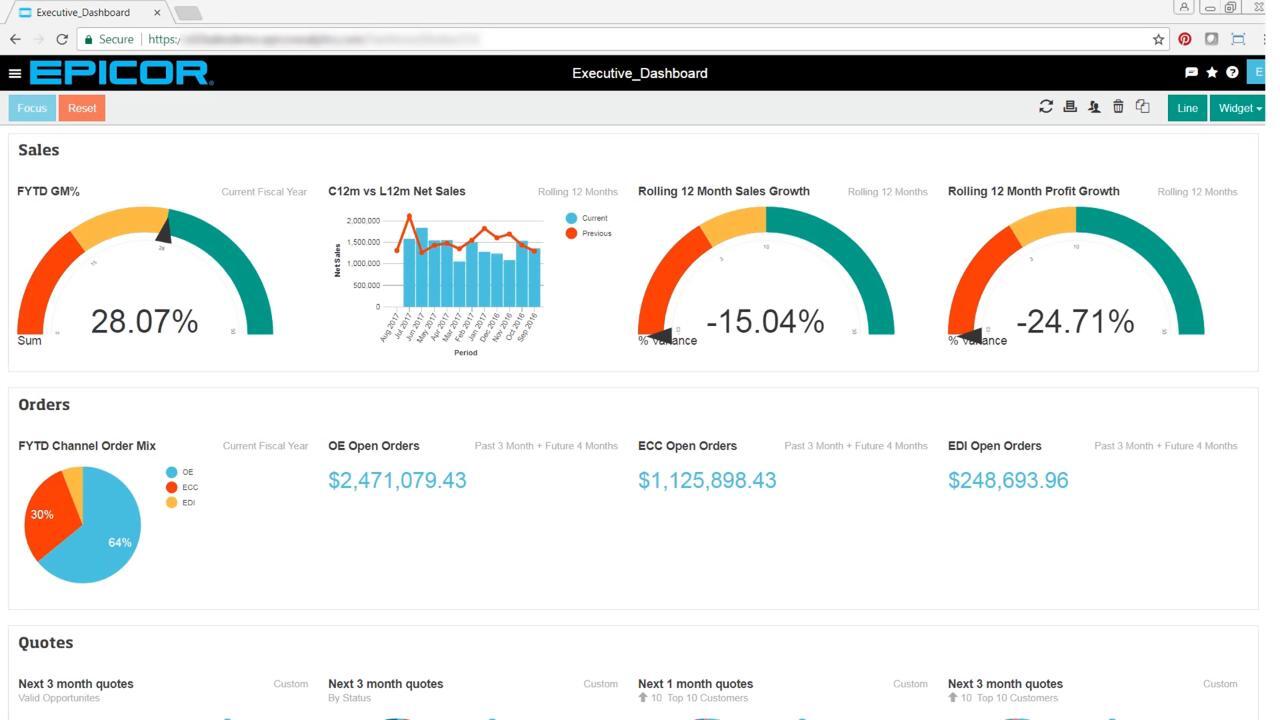
Epicor is an ERP platform designed for manufacturers, distributors, and supply chain businesses that need industry-specific functionality. It combines ERP, supply chain management, and analytics tools with AI-powered applications that support forecasting, automation, and operational planning. Epicor also provides cloud deployment options and industry-focused solutions that align with manufacturing and distribution workflows.
Best for: Manufacturers and distributors with complex supply chains
Features:
- AI-powered forecasting and planning tools: Uses machine learning to support demand planning, inventory optimization, and financial forecasting
- Supply chain and inventory management: Tracks inventory, orders, and logistics across operations
- Embedded analytics and business intelligence: Provides reporting and data analysis across production and financial data
- Workflow automation and integration tools: Automates processes and connects systems through integration capabilities
Pros:
- Deep manufacturing functionality covering traceability, supply chain, and real-time financial reporting
- High customizability through flexible tools that teams can configure to match specific production workflows
- Competitive pricing for teams under 200 users compared to larger ERP vendors
Cons:
- Customer support quality is inconsistent, with users frequently citing poor response times and siloed expertise
- The out-of-the-box experience can feel clunky, requiring significant customization before teams can work efficiently
Pricing: Pricing not listed on website
4. Infor CloudSuite Industrial

Infor CloudSuite Industrial is a cloud ERP system designed for manufacturers with complex, industry-specific requirements. It combines core ERP functionality with MES, WMS, PLM, and CPQ to support production, inventory, supply chain, and product lifecycle workflows. Infor CloudSuite Industrial also provides micro-vertical functionality and connects with other tools through the Infor Industry Cloud Platform.
Best for: Manufacturers with complex, industry-specific operational requirements
Features:
- Industry-specific ERP and micro-vertical support: Supports discrete and process manufacturing with tailored functionality
- AI-powered analytics and insights: Provides data-driven insights for planning, quality, and operations
- Integrated manufacturing and supply chain tools: Connects MES, WMS, PLM, and ERP in one system
- Real-time visibility and reporting: Tracks production, inventory, and supply chain data across operations
Pros:
- Strong traceability and quality management built directly into production workflows
- Scalable cloud infrastructure with built-in customization and automation capabilities
Cons:
- The learning curve is significant, with users reporting it takes considerable time to fully learn the system
- Documentation lacks specificity for certain use cases, making some configurations difficult to complete without outside help
Pricing: Pricing not listed on website
5. Microsoft Dynamics 365


Microsoft Dynamics 365 is a cloud-based ERP and CRM system that connects finance, supply chain, sales, and service operations in a single environment. It uses AI capabilities, including Copilot and embedded agents, to automate workflows, analyze data, and support operational decision-making. The system integrates with Microsoft tools such as Power BI and Microsoft 365, enabling data sharing, reporting, and process management across teams. It also supports modular deployment, allowing businesses to select and expand applications based on operational needs.
Best for: Enterprises needing integrated ERP and CRM systems
Features:
- AI-powered agents and Copilot tools: Automates workflows, supports decision-making, and assists with daily tasks
- Integrated ERP and CRM applications: Connects finance, supply chain, sales, and customer service
- Data analytics and reporting with Power BI: Provides dashboards and insights across business functions
- Modular and scalable architecture: Allows businesses to deploy and expand applications as needed
Pros:
- Seamless Microsoft ecosystem integration with Excel, Outlook, Teams, and Power BI that teams already use
- Scalable and modular architecture that grows from small teams to enterprise without switching systems
- AI-powered Copilot tools that automate workflows and surface real-time insights across finance and operations
Cons:
- Implementation complexity frequently requires external partners and technical resources, adding cost and time
- Advanced configurations require developer-level skills, and third-party integrations don't always connect without additional work
Pricing: Varies based on selected Dynamics 365 applications and licensing
6. Oracle NetSuite

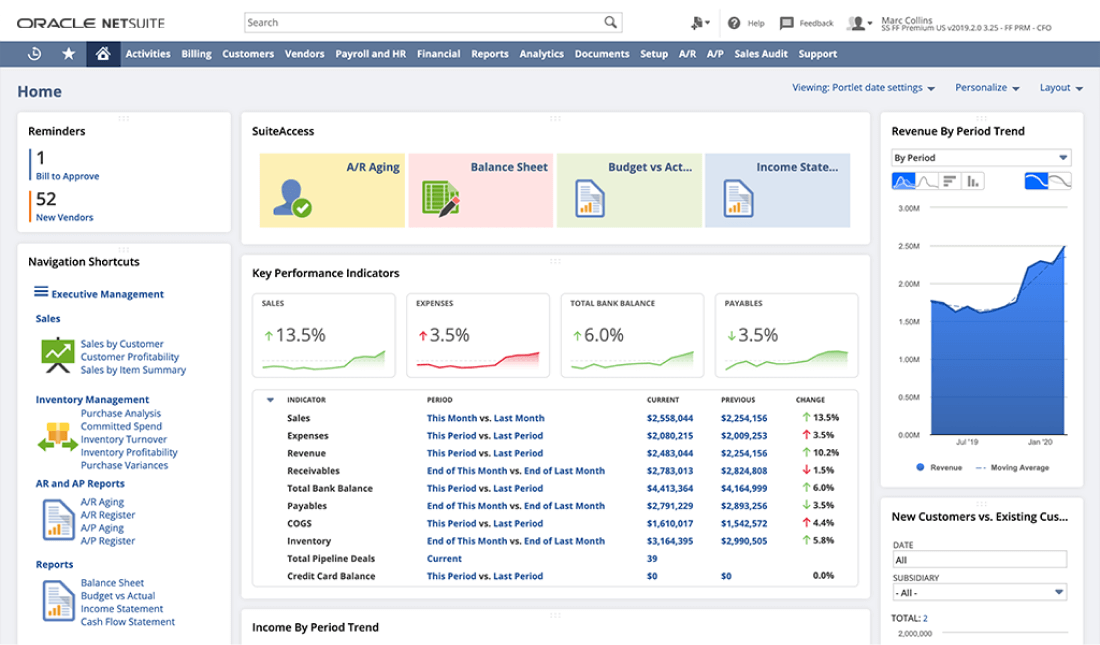
Oracle NetSuite is a cloud-based ERP solution that connects financials, CRM, ecommerce, and core business operations in one environment. It includes AI capabilities such as natural language search, conversational tools, and automated workflows that support data analysis and operational tasks. The software provides real-time visibility across functions and maintains a centralized data model for reporting, planning, and process management. It also supports global businesses with tools for financial management, inventory, and order processing.
Best for: Businesses needing unified ERP across global operations
Features:
- Unified business management suite: Connects financials, CRM, ecommerce, and operations in one environment
- AI-powered automation and workflows: Supports task automation, natural language search, and conversational tools
- Real-time visibility and reporting: Provides centralized data for analytics and operational tracking
- Financial and global management tools: Supports accounting, compliance, and multi-entity operations
Pros:
- Unified platform consolidating financials, inventory, CRM, and reporting without requiring separate tools
- Strong scalability supporting growth into new markets, entities, and currencies without a system change
- Real-time dashboards and reporting giving teams immediate visibility into financial and operational performance
Cons:
- Additional modules for key capabilities carry extra cost, often pushing total spend beyond the base license
- The learning curve is steep, with a complex interface that frequently overwhelms new users and requires extended onboarding
Pricing: Pricing not listed on website
7. SAP S/4HANA

SAP S/4HANA is a cloud ERP solution designed for large enterprises that need standardized processes across finance, supply chain, manufacturing, and operations. It includes built-in AI, machine learning, and automation tools that support planning, analytics, and process execution. The software uses preconfigured business processes and real-time data to manage core functions, while also supporting integration with other enterprise applications and extensions. It supports global operations with localization capabilities and tools for compliance, reporting, and scalability.
Best for: Large enterprises with complex, global operations
Features:
- Preconfigured business processes: Uses standardized workflows across finance, supply chain, and operations
- AI and automation capabilities: Supports analytics, planning, and process execution
- Real-time data processing and reporting: Provides visibility across business functions
- Enterprise integration and extensibility: Connects with other applications and supports custom extensions
Pros:
- Preconfigured best-practice workflows that reduce implementation time and help teams follow industry standards
- Real-time analytics embedded in transactions enabling faster, more accurate decision-making
- Seamless integration and scalability across SAP's ecosystem and third-party tools
Cons:
- High cost of ownership combined with limited customization flexibility in the cloud version
- The implementation process requires skilled consultants and considerable time, creating a significant barrier for organizations without dedicated SAP expertise
Pricing: Pricing not listed on website
Features to Look for in AI ERP Software
AI ERP systems vary in how they apply automation, analytics, and intelligence across operations. As more platforms embed AI capabilities, you need to evaluate how those features support real manufacturing workflows. Gartner predicts that 40% of enterprise applications will include task-specific AI agents by 2026, so it's important to look at how each system applies AI in practice:
- Compliance-focused AI capabilities: Look for systems that use AI to standardize QA processes, automate documentation, and support audit readiness, rather than relying only on predictive analytics.
- Real-time data processing: Choose platforms that update data continuously so your team can act on current information, not delayed reports.
- Integration capabilities: Select software that connects with accounting, MES, ecommerce, and supply chain tools to keep data consistent across systems.
- Traceability and compliance features: Prioritize solutions that track ingredients, batches, and processes with full audit trails to support regulatory requirements.
- Scalability: Pick a platform that can support growth across products, facilities, and production volumes without major system changes.
Benefits of AI ERP Software
AI ERP systems improve how manufacturers manage operations, data, and decision-making. In advanced manufacturing environments, AI-based use cases have delivered a 2–3x increase in productivity. Here are other benefits to consider:
- Reducing manual processes and workflows: Eliminates repetitive tasks and manual data entry so teams can focus on higher-value work.
- Streamlining efficiency and productivity: Improves production, inventory management, and planning to reduce delays and increase output.
- Strengthening decision-making with better data insights: Provides real-time analytics and more reliable traceability to support faster, more informed decisions.
- Improving compliance and audit readiness: Maintains accurate records, automates documentation, and simplifies regulatory reporting.
- Reducing human error: Minimizes mistakes through automation, validation rules, and consistent data handling.
- Standardizing quality and production processes: Ensures consistent workflows and reduces variability in regulated environments.
- Improving supply chain management: Increases visibility across suppliers, inventory, and logistics to reduce disruptions and delays.
- Enhancing customer and employee experience: Supports faster order fulfillment, clearer communication, and more efficient internal workflows.
The State of AI in ERPs Today
AI is becoming a core part of ERP systems, but its most practical applications today are in workflow automation and compliance support. For manufacturers in regulated industries, the biggest gains come from reducing manual QA work, improving traceability, and maintaining consistent documentation across production.
Businesses Need More AI Expertise
Many organizations want to adopt AI but lack the expertise to use it effectively. That gap limits the value ERP systems can deliver. According to Gartner, 77% of CEOs believe AI is shaping a new business era, yet many don't think their teams are ready to execute. AI adoption requires more than access to tools. Teams need to manage data, configure workflows, and apply AI in real operations. Without those skills, systems don't deliver.
Many ERP Systems Aren't AI-Ready
AI capabilities are advancing quickly, but many ERP systems still rely on outdated infrastructure. Legacy platforms struggle to support real-time data and automated workflows. According to Gartner, 63% of organizations lack confidence in their AI data practices. AI depends on clean, structured, and accessible data. Many teams still manage fragmented or inconsistent data across systems. That limits how effectively AI can operate. Modern, cloud-based ERPs handle real-time processing and connect data across workflows. Older systems force teams to rely on manual workarounds, slowing operations.
AI ERP Software FAQs
How is AI used in ERP systems?
AI is used in ERP systems to automate workflows, improve data accuracy, and support faster decision-making across operations. In many systems, it helps streamline processes like reporting, anomaly detection, and operational insights.
In regulated manufacturing environments, AI is increasingly applied to compliance and quality workflows. This includes helping teams create and manage QA tests, maintain audit-ready documentation, track traceability data, and identify inconsistencies before they become compliance issues.
Rather than replacing core ERP functionality, AI enhances how teams manage complex processes, reducing manual work while improving consistency and visibility across production and compliance.
What's the difference between traditional ERP and AI ERP?
Traditional ERP systems rely on manual inputs, fixed rules, and historical reporting. AI ERP systems add machine learning, predictive analytics, and automation. This allows teams to move from reactive processes to proactive planning, with systems that adapt to changes and provide real-time insights.
Will AI replace ERP systems?
No. AI enhances ERP systems rather than replacing them. ERP remains the operational backbone of a manufacturing business, housing the data, workflows, and business logic that connect purchasing, production, inventory, and finance. AI needs that infrastructure to function.
What's changing is the role ERP plays. As McKinsey notes, AI use cases rely heavily on the data and applications housed in ERP systems. Organizations that treat ERP as legacy baggage risk undermining their own AI investments. The manufacturers seeing the strongest returns aren't replacing their ERP — they're choosing platforms where AI is built into the core.
Find the Best AI ERP Software for Your Business With Wherefour
AI is changing how manufacturers manage compliance, quality, and traceability. Teams need systems that connect data, automate workflows, and support faster decisions across operations.
Wherefour brings these capabilities together into a single platform built for manufacturers. It combines real-time inventory tracking, production planning, lot traceability, and AI-assisted compliance tools. Teams can manage production, reduce stock issues, and generate recall reports in minutes from a single system.
As your business grows, your ERP system needs to keep pace. Wherefour supports multi-product operations, integrates with tools like QuickBooks and Xero, and keeps data connected across every stage of production.
Get a demo and see how Wherefour can support your production, inventory, and compliance workflows.
